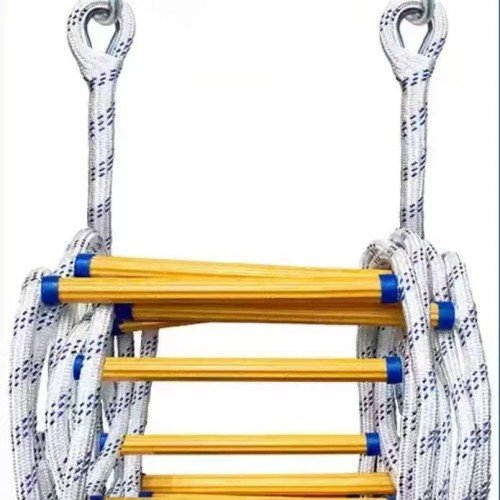
The plastic rope ladder (resin soft ladder) is a lightweight, high-strength emergency climbing and escape equipment, strictly manufactured in accordance with GB 27901-2011 and relevant fire escape equipment standards. The main body is woven with **high-toughness engineering resin/plastic rungs** and **high-strength polyester multifilament rope**, offering core advantages over traditional wooden or metal ladders: light weight, non-absorbent, corrosion-resistant, aging-resistant, good insulation, and slip-resistant with easy grip. The overall structure is stable, with evenly spaced rungs (standard 400mm), and the surface is treated with anti-slip texture to prevent slipping during climbing; the main rope diameter is not less than 14mm, and some models have a built-in steel wire core to enhance fire resistance and tensile strength, with high breaking strength and a large safety factor. It can be folded and stored in a dedicated bag, taking up minimal space for easy storage and portability; in an emergency, it can be quickly deployed, securely hung from load-bearing structures such as windowsills, railings, or brackets via the top double safety hooks, and used vertically without the need for installation tools. Suitable for building fire emergency escape, outdoor high-altitude work, ship boarding, mine/tunnel maintenance, electrical insulation climbing, flood control and rescue, and many other scenarios. It is a flexible and safe alternative to traditional rigid ladders, with complete certifications and test approval, and can be supplied in bulk for households, property management, factories, construction sites, ships, and other fields.
Usage Instructions and Operating Specifications: **Storage and Care**: - Store in a dry, well-ventilated, cool place, away from high temperatures, open flames, chemicals, sharp objects, and direct sunlight. - Fold neatly and place in the storage bag, avoiding heavy pressure, twisting, or prolonged dampness to prevent rope aging and rung cracking. - Inspect monthly: check the main rope for wear, broken filaments, fuzzing, or discoloration; check rungs for cracks, damage, or looseness; check hooks for deformation or rust. - If obvious wear, deformation, aging, or chemical corrosion is found, discontinue use immediately and replace; never use a damaged ladder. **Pre-Use Inspection**: - Confirm the ladder is intact: no broken filaments, no damage, rungs secure, hooks not deformed, and locks reliable. - Check that the anchor point (windowsill, railing, pipe, bracket) is sturdy and can bear ≥500kg; never anchor to unstable structures. - Confirm sufficient length: after hanging, the lower end should be ≤0.5m from the ground/safety platform to avoid excessive dangling. **Operating Steps**: 1. Unfold the ladder and securely attach the top double safety hooks to a reliable anchor point, ensuring the locks are fully closed and not loose. 2. Hang the ladder vertically out the window/down, keeping it naturally straight, avoiding twisting, tangling, or friction against sharp edges. 3. When climbing, **face the ladder and maintain three points of contact** (two hands and one foot, alternating), keep your body close to the ladder, grip the rope on both sides, and step on the ends of the rungs (not the middle). 4. Never release both hands at the same time; climb at a steady pace, do not jump, swing, or apply lateral force to prevent the ladder from swaying or flipping. 5. For multiple users, **one person per ladder, climb one at a time**; never allow multiple people on the ladder simultaneously to avoid overloading. 6. For work at heights over 2 meters, a safety harness and helmet must be worn, with a separate safety rope attached to a reliable anchor point for dual protection. **Post-Use Maintenance**: - Clean dirt, sand, and debris from the rungs and rope, wipe with a dry cloth, and air dry in a cool place; never expose to direct sunlight or heat. - Inspect for damage: broken filaments in the rope, cracks in rungs, hook deformation, and record any issues; stop use immediately if abnormalities are found. - Fold neatly and place back in the storage bag, store in a designated location for quick emergency access. **Safety Precautions**: - Use only for emergency escape and work climbing; never use for lifting, towing, swinging, or other purposes. - Untrained personnel, the elderly, the infirm, pregnant women, children, and intoxicated persons must not use the ladder alone. - Avoid prolonged use in environments with open flames, high temperatures, heavy smoke, or strong corrosion (except fire-resistant models). - Do not climb while the ladder is swaying; wait until it is stable. A designated person should supervise below to prevent accidents. - Regularly (quarterly) have the ladder inspected or professionally checked; mandatory retirement and replacement upon reaching the service life (generally 3–5 years). Service hotline: 130-6003-1111