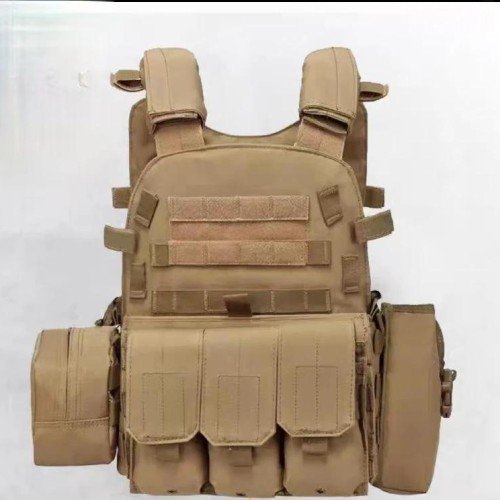
Load-bearing tactical vest for wildland crews — modular pouches for tools, radio and hydration.
Values are industry-standard ranges; final configuration subject to scheme design.
| Model | SL-SF03 (Third Generation Standard Edition) |
| Material | Main body — Aramid flame-retardant fiber/1000D flame-retardant Oxford fabric |
| Color | Orange-red (high visibility) / Khaki (camouflage) |
| Sizes | One size fits most (adjustable, fits heights 165-185cm) |
| Weight | Approx. 1.2-1.5kg (empty) |
| Function Modules | MOLLE webbing system, 8 detachable accessory pouches, 3L hydration bladder compartment, rescue drag handle |
| Pocket Configuration | Main pockets ×2, side pockets ×4, inner pockets ×2, tool insert pockets ×3, hydration bladder sleeve ×1 |
| Adjustment System | Shoulder straps: 4 adjustments, waist belt: 6 adjustments, chest strap: 2 adjustments |
| Reflective Performance | High-visibility reflective strips, visible at night up to 300 meters |
| Flame Retardant Performance | Self-extinguishing, withstands 350°C, resistant to heat radiation |
| Tear Strength | Warp direction ≥3000N, weft direction ≥3000N |
| Water Bag Capacity | Standard 3L separate water pouch (optional 2L) |
| Operating Temperature | -40℃~+70℃ |
| Protection Rating | IP64, dustproof, splash-proof, abrasion-resistant and tear-resistant |
| Service Life | Normal service life 3-5 years; regular maintenance can extend it |
| Accessories | First aid kit ×1, canteen pouch ×1, tool bag ×2, supply bag ×2, water bladder ×1, raincoat pouch ×1 |
Certification: Test Report, Factory Certificate of Conformity · Customization (explosion-proof, anti-corrosion etc.) available
The forest fire tactical vest is specifically designed for forest firefighting, mountain rescue, and field emergency scenarios. It is a core individual equipment item integrating protection, load-carrying, and portability, meeting forest fire protection standards and adapting to high-intensity operations in complex terrain. - *Flame-retardant protection: The main body uses aramid fiber/1000D densified flame-retardant Oxford fabric, resistant to high temperatures and sparks, providing short-term protection against direct flame contact, effectively blocking heat radiation, and preventing clothing ignition and burns. - Modular combination system: Equipped with standard MOLLE laser-cut webbing, it allows free attachment of 8 functional modules such as first aid kits, water bottle pouches, hydration bladders, tool pouches, and supply pouches, which can be combined as needed for convenient access. - Ergonomic lightweight design: Mesh lining* wicks moisture and breathes; shoulders/waist have multi-position adjustment to fit different body types; rear rescue drag handle enables quick and safe evacuation of personnel in danger. - High-visibility safety warning: 360° high-brightness reflective strips all around, with visibility distance ≥300 meters at night/in heavy smoke, significantly enhancing team recognition and operational safety. - Large-capacity carrying capability: Built-in 2L/3L hydration bladder compartment, multiple internal and external pockets, can carry firefighting tools, communication equipment, first aid supplies, and food supplies to meet long-duration operational needs. - Durable and tear-resistant: Fabric tear strength ≥5000N, key areas double-reinforced, abrasion-resistant, scratch-resistant, and resistant to branch tearing, suitable for complex mountain forest environments. - All-weather adaptability: Operating temperature -40°C~+70°C, waterproof and moisture-proof, no mildew, no deformation, stable performance during long-term outdoor storage
Usage instructions and operating specifications: Preparation before use - Visual inspection: Check the vest for damage, loose threads, or burn marks; ensure zippers, hook-and-loop fasteners, and buckles are smooth and secure; reflective strips are intact. - Module assembly: Attach modules such as first aid kits, hydration bladders, and tool pouches according to the mission, ensuring they are firmly fixed and positioned for convenience. - Size adjustment: Loosen shoulder straps, waist belt, and chest strap; put on the vest over the head; adjust to fit the body snugly without being too tight or loose, allowing free movement. - Hydration bladder installation: Insert the 3L hydration bladder into the back compartment, connect the tube to the shoulder, and check for leaks and unobstructed water flow. - Safety check: Confirm the rescue drag strap, reflective strips, and all fasteners are in good condition; load is balanced and does not hinder movement. Operation steps - Standard wearing: Lay the vest flat, put it on over the head, tighten shoulder straps → fasten chest strap → adjust waist belt to ensure stability and comfort. - Module access: Place first aid kits, tools, and water bottles in easily accessible chest positions; position the hydration tube on the shoulder for convenient hydration. - Movement guidelines: Maintain center of gravity stability when moving through mountain forests, avoid snagging on branches; check equipment for looseness when bending or climbing. - Rescue operation: When a teammate is in danger, firmly grasp the rear drag handle and smoothly drag them to safety, avoiding secondary injury. - After operation: First remove modules → then loosen waist belt → unfasten chest strap → loosen shoulder straps → take off the vest, and organize systematically. Post-use maintenance - Cleaning and care: Hand wash with mild detergent or gentle machine wash (≤40°C); do not use bleach or fabric softener; dry in a ventilated, shaded area; do not expose to direct sunlight or high-heat drying. - Component inspection: After cleaning, check fabric, seams, zippers, fasteners, and reflective strips; repair or replace damaged parts promptly. - Module organization: Empty all pockets and store accessory pouches dry; empty, clean, and dry the hydration bladder to prevent mildew. - Storage: Fold or hang in a dry, ventilated, cool place away from sharp objects, acids, alkalis, and fire sources; avoid heavy pressure deformation. - Regular maintenance: Check flame retardancy, reflectivity, and component firmness monthly; perform quarterly* maintenance to extend service life. Safety precautions - Must be used with flame-retardant clothing, fireproof boots, flame-retardant gloves, and goggles to form a complete protection system. - Strictly avoid prolonged direct contact with open flames; avoid exposure to high temperatures and molten metal splashes to prevent fabric damage. - Load weight shall not exceed 15kg, maintain front-rear balance to avoid imbalance affecting operational safety. - No solo operations in mountain forests; maintain team spacing and ensure reflective markings are clearly visible. - Do not modify, cut, or repair the main structure of the vest to avoid compromising flame retardancy and structural strength. - If damage, burns, seam splits, or reflective failure are found, stop use immediately and replace; never use defective equipment. - Keep away from sharp objects, chemicals, and oil to prevent punctures, corrosion, and contamination, protecting protective performance. - Untrained personnel must not operate, disassemble, or modify; for forest firefighting and emergency rescue use only; prohibited for other purposes. Service hotline: 130-6003-1111
1. Forest firefighting: Carry firefighting tools, water sources, and first aid supplies, moving through dense forests* to extinguish fires, with flame-retardant protection and safety reflective features. 2. Mountain emergency rescue: For mountain search and rescue, geological disaster rescue, modular load-carrying of equipment, drag handle ensures safe transfer of injured persons. 3. Field patrol and duty: Daily patrols in forest farms and nature reserves, carrying communication, supplies, and first aid items, lightweight and durable. 4. Firefighting drills: For forest fire brigade training and exercises, simulating real combat equipment carrying, enhancing joint operational capability. 5. Multi-scenario emergency operations: Grassland firefighting, mine rescue, field construction, camping and adventure, etc., as a universal emergency carrying equipment. 6. Disaster relief support: For rescue operations in floods, earthquakes, etc., carrying materials, tools, water, and food, supporting high-intensity continuous operations.
Nationwide direct logistics delivery; acceptance documents are handed over with the goods. Warranty and after-sales terms are subject to the supply contract. Government and enterprise group purchases are supported. For details, call for consultation.