I. Product Introduction and Application Scenarios
The forest fire prevention electric reciprocating water gun is a portable firefighting device driven by a lithium battery-powered reciprocating pump, capable of continuous or pulsed spraying of fine water mist or straight stream. It is commonly used in forest fire prevention patrols, initial fire suppression, and cooling isolation during confined space rescue. Its core advantages include no need for an external power source, rapid startup, and strong water mist penetration, making it suitable for rapid deployment in narrow, oxygen-deficient, or water-source-remote areas.
Suitable Working Conditions
- Initial fire suppression and smoke cooling in confined spaces (such as underground utility tunnels, storage tanks, and tunnels).
- Extinguishing surface fires and cleaning up residual embers during forest fire prevention patrols, or coordinating with wind-driven fire extinguishers for "wind-water combined" operations.
- Rapidly establishing mobile water mist barriers at emergency rescue sites to isolate thermal radiation or dilute toxic gases.
- Independent operation with backpack-type or handheld electric water guns in remote forest areas or locations inaccessible to vehicles.
Unsuitable Working Conditions
- Frontal attack on large-scale, high-intensity forest fires — requires portable fire pumps and forest fire water bags to establish remote water supply.
- Uninterrupted firefighting lasting several hours or more — battery endurance and water tank capacity are limited, requiring rotation or external water sources.
- Live electrical equipment fire scenarios without power disconnection — water mist still poses electrical conductivity risks, requiring power disconnection or insulating extinguishing agents.
- Long-term outdoor storage in severe cold environments — lithium batteries degrade significantly at low temperatures and require thermal management.
II. Core Technical Parameters and Configuration Standards
During selection, focus on pressure, flow rate, endurance, and interface compatibility. The following are common industry ranges; refer to manufacturer test reports for specific values.
| Parameter | Typical Range | Notes |
| Rated working pressure | 0.4–1.2 MPa | Higher pressure means longer range, but increases power consumption and recoil force |
| Flow rate | 2–8 L/min | Fine mist mode has lower flow rate; straight stream mode has higher flow rate |
| Battery voltage/capacity | 36–60 V / 10–30 Ah | Endurance approximately 30–90 minutes, depending on spray mode |
| Water tank capacity | 5–20 L | Can be connected to forest fire water bags or portable fire pumps |
| Range | 8–15 m (straight stream) | Fine mist mode has slightly shorter range but more uniform coverage |
| Protection rating | IP54–IP67 | IP65 or above recommended for humid confined space environments |
| Interface specification | DN25/DN40 quick coupling | Must match existing local hose and water gun interfaces |
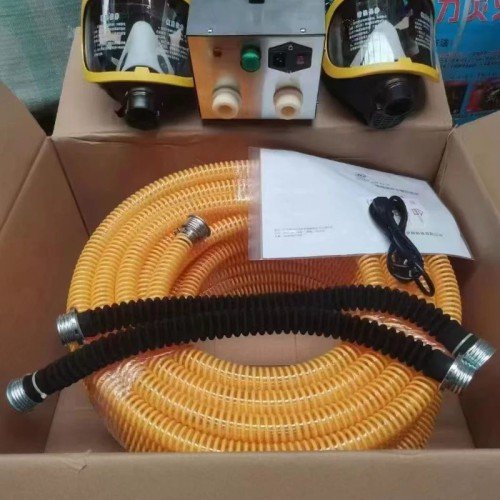
In confined space rescue, if simultaneous long-distance air supply and gas displacement are required, it can be used with a two-person electric long-tube air supply blower to form a "air supply + water mist cooling" coordinated solution.
III. Local Procurement and Implementation Pain Points
When procuring electric reciprocating water guns locally, equipment departments often face the following common pain points:
- Climate differences: Local high temperature and humidity or severe cold affect battery life and seal aging rates, requiring targeted selection of protection ratings and battery thermal management solutions.
- Logistics timeliness: When remote forest areas or emergency warehouses have insufficient stock, emergency replenishment cycles are long, affecting dispatch response.
- Interface compatibility: Existing local hose and water gun interface standards vary. Without confirming DN specifications in advance, quick connection on site is impossible.
- After-sales response: Without local service outlets, battery and pump repairs take long cycles, affecting combat readiness rates.
- Policy compliance: Government and enterprise centralized procurement requires test reports, fire product certifications, and other qualifications; missing items will result in bid rejection.
- Terrain limitations: Mountains, steep slopes, or narrow utility tunnels impose high requirements on equipment weight and portability, requiring a balance between capacity and mobility.
IV. Common Misconceptions in Selection and Procurement
- ❌ Focusing only on price while ignoring battery cycle life and protection rating. ✅ Prioritize models with IP65 or above, removable batteries, and cycle count ≥800.
- ❌ Assuming higher pressure is always better. ✅ For confined space rescue, medium-low pressure fine mist mode is preferable to avoid high-pressure jets disturbing smoke or causing personnel injury.
- ❌ Ignoring interface compatibility. ✅ Confirm local hose coupling specifications before procurement and require manufacturers to provide adapter solutions.
- ❌ Not considering low-temperature endurance degradation. ✅ Choose models with battery insulation compartments or external power support, and equip spare batteries.
- ❌ Treating electric water guns as primary firefighting equipment. ✅ They should be positioned for initial suppression and cooling isolation, coordinated with wind-driven fire extinguishers and portable fire pumps as a system.
- ❌ Neglecting routine maintenance. ✅ Clean filters and check seals after each use; store batteries at 50%–80% charge.
- ❌ Procuring products without test reports. ✅ Require third-party test reports and fire product certifications to ensure bid compliance.
V. Criteria for Selecting Reliable Manufacturers and Service Providers
When evaluating suppliers, it is recommended to assess neutrally from the following dimensions:
- Complete qualifications: Possession of fire product certifications, test reports, and ISO quality management system certificates.
- Workmanship and testing: Clear supplier traceability for pumps, batteries, and seals; pressure and endurance testing before factory delivery.
- After-sales network: Ability to provide spare parts replacement, battery repair, and technical support locally or nearby.
- Inventory and lead time: Stock or short lead times for common models; support for batch supply in government and enterprise centralized procurement.
- Compliance support: Ability to provide qualification documents, parameter specifications, and after-sales commitment letters required for bidding.
- Verifiable cases: Supply records for similar working conditions such as forest fire prevention and confined space rescue.
VI. Real Project Case
During a confined space rescue drill, the equipment department of a local fire rescue station needed to rapidly cool and isolate a simulated fire point in an underground utility tunnel. Previously, manual water guns were used, which were slow to deploy and provided uneven mist coverage. Later, electric reciprocating water guns were configured (working pressure approximately 0.8 MPa, fine mist mode, IP65 protection, external 10 L water bag), combined with a two-person electric long-tube air supply blower for gas displacement. Drill results showed: initial fire point suppression time was reduced by approximately 40%, the temperature inside the utility tunnel dropped to the safe range within 5 minutes, and smoke exhaust efficiency was significantly improved. The equipment department feedback indicated that battery endurance met single drill requirements, interfaces matched existing hoses well, and routine maintenance only required cleaning filters and checking seals.
Summary: The forest fire prevention electric reciprocating water gun is positioned as initial suppression and cooling isolation equipment in confined space rescue. Selection should focus on pressure range, protection rating, interface compatibility, and battery endurance, and procurement should verify qualifications and after-sales service. For supporting air supply and remote water supply solutions, consult Longsheng An Fire Protection (Tel: 13060031111) for product selection and bidding support.